
June 21, 2024
Kabul- The UN is currently developing a Global Digital Compact that will outline shared principles for an open, free, and secure digital future for all. The Afghanistan Journalists Center (AFJC) has joined the Global Forum for Media Development (GFMD), DW Akademie and other organizations in calling for the Global Digital Compact to reflect and enhance international human rights standards, particularly in regards to access to information, freedom of expression, and media freedom. We believe that the media community should be considered a key stakeholder in internet governance discussions.
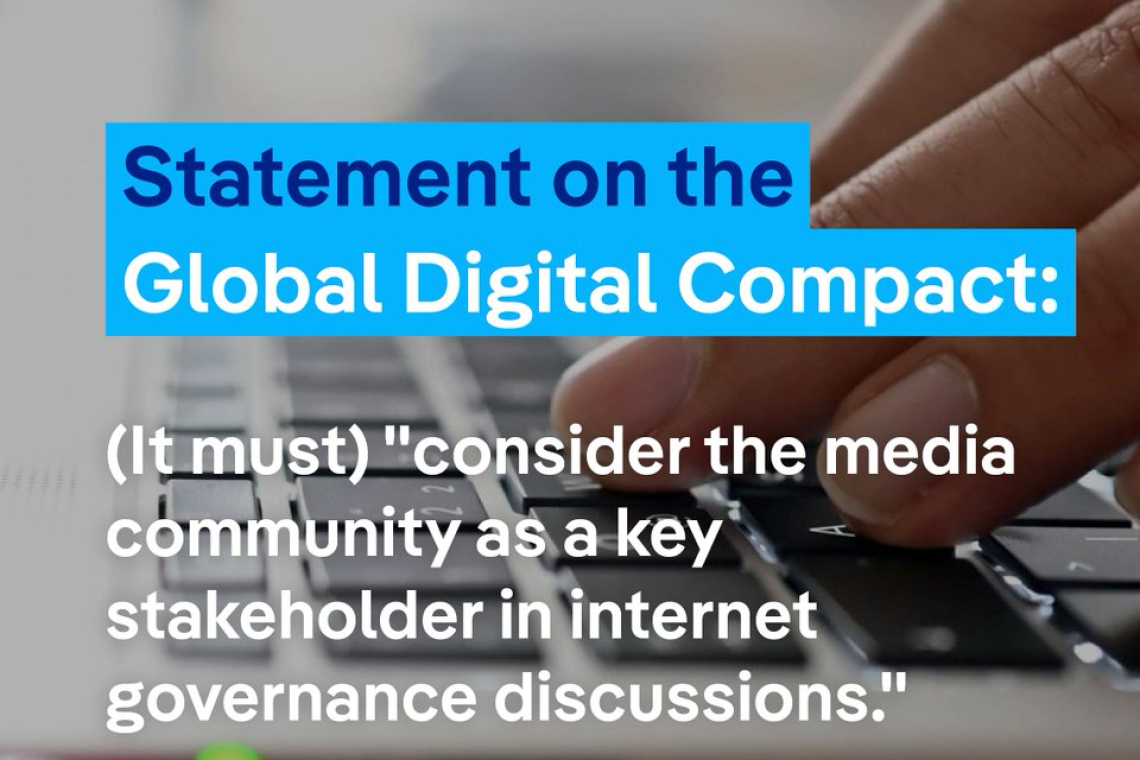
Statement on the Global Digital Compact:
In the lead-up to the Summit of the Future in September 2024, a coalition of organisations are calling on the United Nations (UN) and its Member States to firmly commit to a human rights-based approach to internet governance within the Global Digital Compact (GDC). The GDC, aiming to promote an inclusive, open, sustainable, safe, and secure digital future for all, must reflect and enhance international human rights standards - particularly concerning access to information, freedom of expression, and media freedom - and consider the media community as a key stakeholder in internet governance discussions.
The Global Digital Compact Must Ensure Human Rights-Based Approaches to Internet Governance
The undersigned organisations urge the United Nations (UN) and its Member States to ensure robust commitments to a rights-based internet as they negotiate the final text of the Global Digital Compact in advance of the Summit of the Future in September.
|
The Global Digital Compact (GDC), which seeks to advance an “inclusive, open, sustainable, safe and secure digital future for all”, will be agreed at the The Summit of the Future in September 2024 and annexed to the Summit’s main outcome document, the Pact for the Future. |
We welcome the May 15 revision of the GDC following the zero draft. We particularly applaud the new paragraph 33 that links information integrity to democratic processes and human rights as well as the inclusion of independent public interest media in paragraph 34(b).
Given the utmost importance of access to information, freedom of expression, and media freedom in the digital sphere in ensuring an inclusive, open, sustainable, safe and secure digital future for all, we call on the UN and Member States to further strengthen their commitments, in line with Article 19 of the Universal Declaration of Human Rights; the General Comment on Article 19: freedoms of opinion and expression; the 1991 Windhoek Declaration; and the 2021 Windhoek+30 Declaration: Information as Public Good, and in fulfilment of target 16.10 of the Sustainable Development Goals (ensure public access to information and protect fundamental freedoms, in accordance with national legislation and international agreements).
We therefore call on the UN and Member States to incorporate the following language into the Global Digital Compact:
|
1. Inclusion of the media community as a relevant stakeholder in internet governance discussions: o Under 6 add: “and media” after “the technical and academic”. o Under 8(k) add: “the media community” after “academia”. 2. Under Objective 3, 23 add: “Protect journalists, media workers, access to information, and human rights defenders in line with international human rights law and international humanitarian law.” 3. Under Objective 3, 30(d) add: “with state obligations” after “in compliance with” and “and with international human rights including freedom of expression and the principles of legality, legitimacy, necessity, and proportionality, and with effective remedies in place. This includes ceasing mass surveillance, refraining from restricting encryption, and establishing clear distinctions between illegal and harmful forms of content” after “in compliance with international law”. 4. Under Objective 3, 35(b) change: “researcher access to data” into “research access to data, including for journalists”. |
We join other organisations in calling for consistent reference to international human rights law and standards, rather than a more general reference to human rights. In particular:
- Under Objective 3, 33, change: “in a manner consistent with human rights” into “through holistic and positive measures grounded in international human rights norms”.
- Under Objective 4, 45, add “with respect to international human rights law, and relevant data protection and privacy norms” after “enable data to flow with trust within and between countries”.
- Under Objective 4, 46(b), add “and in line with international human rights law” after “sharing of cross-border data where relevant”.
Additionally, we would also welcome the following additions to the text:
- Under 2 add: “and governance that aligns with the promotion and protection of human rights” after “and within countries”.
- Under 4 add: “Our goal is an inclusive, open, sustainable, safe, accessible, and secure digital future for all.”
- Under 7 (3) add: “accessible” before “secure digital space”.
- Under 7 (4) change: “responsible” to “accountable”.
- Under 17(a) add: “accessible” before “safe and secure”.
- Under 17(c) add: “affordable” after “inclusive”.
- Under Objective 1, 11(h) add: “including efforts to combat online gender-based violence” after “connectivity for all women and girls”.
- Under Objective 1, 12 add: “and media literacy” after “the importance of digital”.
- Under Objective 1, 15 add: “human rights-based, accountable” after “Transparent”.
- Under Objective 2, 19 add: “and intellectual property rights” after “consumer rights”.
- Under Objective 3, 32 add: “Independent media play a vital role in providing access to trustworthy and pluralistic information” after “safe and secure digital space”.
- Under Objective 3, 34(b) add: “as well as creating an enabling safe digital environment for independent journalism, including but not limited to legal frameworks.” after “independent public interest media”.
- Under Objective 5, 47, add “human rights-centred” after “inclusive”.
Incorporating the recommended language above will help ensure the Global Digital Compact conforms with international human rights law, including existing standards on access to information and freedom of expression, contributes to overcoming digital and societal divides and serves as a truly inclusive framework towards a digital future for all of humanity.
For more information about the community’s advocacy around the Summit of the Future see https://gfmd.info/briefings/gfmds-efforts-around-the-summit-of-the-future/.
Signatories
- Afghanistan Journalists Center(AFJC)
- Bangladesh NGOs Network for Radio and Communication (BNNRC)
- Beam Reports
- Daily Nawa-I-AhmedPurSharqia Pakistan
- DW Akademie
- Freedom Forum Nepal
- Global Forum for Media Development
- Media Voice
- National Union of Journalists of Ukraine
- Rural Media Network Pakistan
- South East Europe Media Organisation (SEEMO)
- World Association for Christian Communication (WACC)