

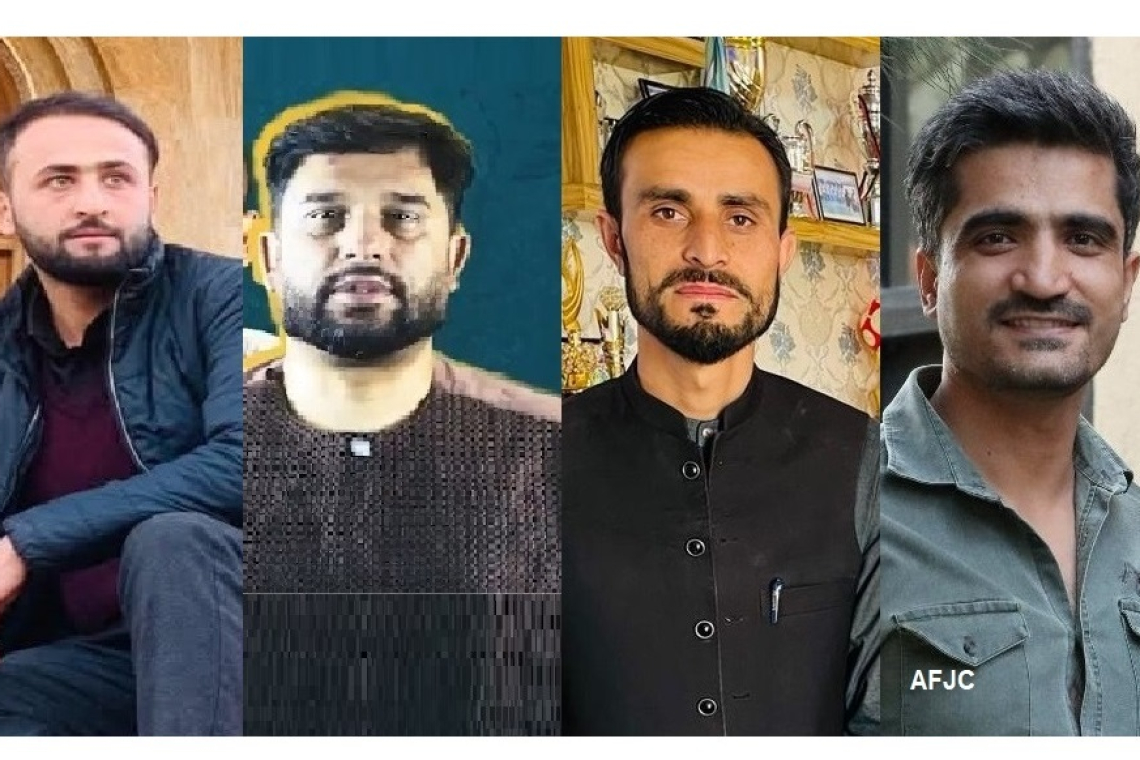
From right: Ahmad Zia Amanyar, a reporter for Radio Begum, Islam Gul Totakhil, Deputy of Radio Jawanan, and Pixel Production employees Ahmad Naweed Asghari and Mushtaq Ahmad Halimi
July 31, 2025
Kabul – The Afghanistan Journalists Center (AFJC) welcomes the recent release of four journalists and media activists in Kabul, including Islam Gul Totakhil, Deputy of Radio Jawanan, and Ahmad Zia Amanyar, a reporter for Radio Begum. Both had been imprisoned for six months. Additionally, Pixel Production employees Ahmad Naweed Asghari and Mushtaq Ahmad Halimi, who had been in custody for two weeks, have also been released.
A journalist in Kabul, who requested to remain anonymous for safety reasons, confirmed that Islam Gul Totakhil and Ahmad Zia Amanyar were released on July 30 after completing six months of imprisonment at Directorate 40 of the General Directorate of Intelligence (GDI) and Pul-e-Charkhi Prison in Kabul.
The source stated that they were sentenced for allegedly engaging in propaganda against the de facto Taliban authorities. On February 4, members of the GDI, in coordination with the de facto Ministry of Information and Culture, raided the offices of Radio Begum and Radio Jawanan in Kabul. During the raid, two employees were detained on charges of producing content for a television outlet located abroad. Computers, hard drives, documents, and personal phones were confiscated. The former director of the radio stations, Asadullah Yousufzai, who was not present during the raid, managed to escape arrest and has since gone into hiding.
Meanwhile, Ahmad Naweed Asghari and Mushtaq Ahmad Halimi of Pixel Production, detained by GDI and morality police on July 15, were released on July 29. They faced accusations of promoting Western culture through translating and dubbing series and collaborating with what de facto authorities deem "malicious" foreign media outlets. The de facto authorities have not publicly commented on their release or clarified the conditions of the detained journalists, nor have they provided information regarding the status of Pixel Production’s office and equipment.
AFJC commends the release of the journalists from Radio Begum and Radio Jawanan, as well as the Pixel Production employees, and emphasizes that their detention and prosecution violate fundamental rights and media freedom in Afghanistan. Their release highlights the urgent need for the de facto authorities to respect media freedom and to cease arbitrary arrests of journalists and media workers. AFJC calls on the de facto authorities to promptly and unconditionally release all detained journalists and media personnel. Media workers must be able to operate freely, without threats, intimidation, or fear of arrest.
According to AFJC’s press freedom tracker, at least eleven journalists and media employees are currently imprisoned or serving sentences in Afghanistan, underscoring the persistent threats to press freedom in the country.