

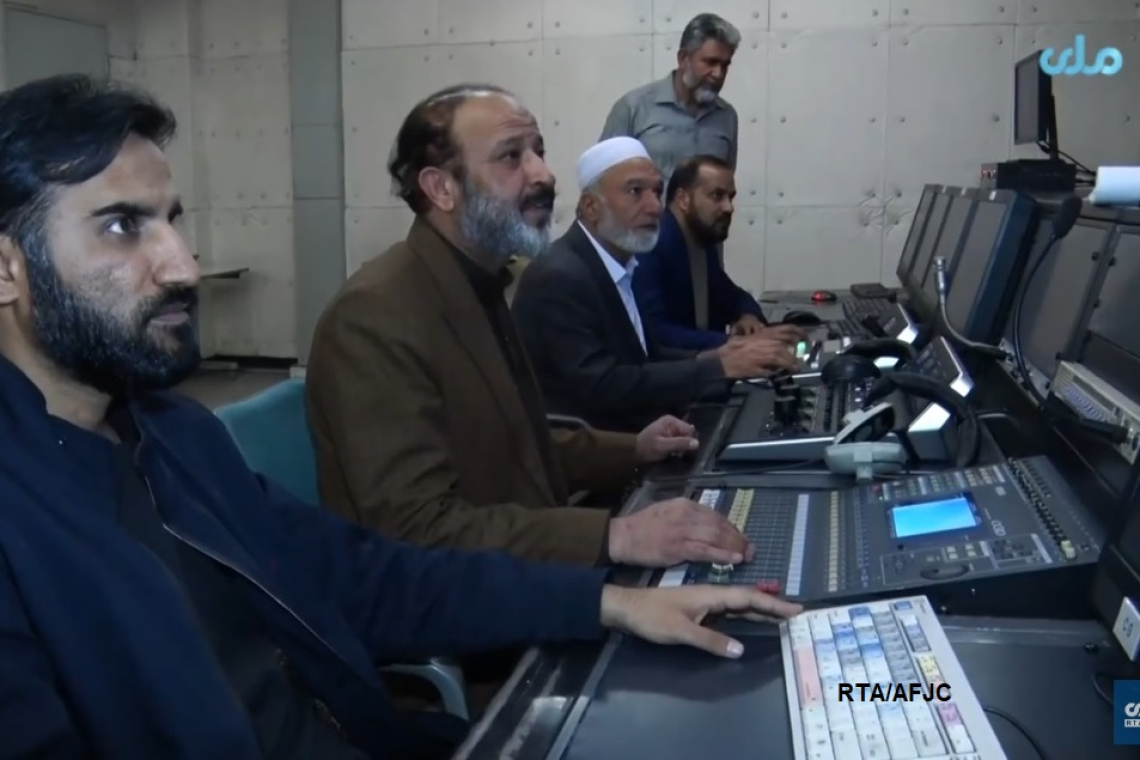
Afghanistan National Radio Television (RTA) studio, Kabul, March 23, 2023
August 14, 2025
Kabul — The Afghanistan Journalists Center (AFJC) documents a troubling increase in threats, arrests, and restrictions targeting media professionals and outlets across Afghanistan, marking the fourth year of Taliban governance. Between August 15, 2024, and August 15, 2025, AFJC recorded at least 190 violations—an uptick from previous years—highlighting a pattern of intensified repression against independent media.
This report underscores the ongoing and expanding efforts by Taliban de facto authorities to suppress critical voices and control information flow. The violations include at least 145 threats—ranging from violence, intimidation, to harassment—and 45 arrests of journalists and media workers. Many of these incidents are linked to the enforcement of the Promotion of Virtue and Prevention of Vice law and recent media directives that restrict coverage and suppress dissent.
One particularly egregious measure is the ban on the publication of images of living beings, initially imposed in Kandahar on August 21, 2024, and subsequently extended to 19 other provinces out of a total of 34. This prohibition has led to the shutdown of at least 32 television stations—both local and national—and 12 private radio stations across 20 provinces. While some broadcasters have resumed limited operations, they now primarily function as radio outlets, significantly reducing their original reporting capacities. Additionally, five radio stations, two television outlets, two media support organizations, and one news agency have been shuttered on charges ranging from propaganda and corruption to alleged collaboration with international organizations and foreign governments. Of these, only one radio station and one television channel have been permitted to reopen after pledging compliance with de facto authorities media policies.
The crackdown extends beyond threats and closures. AFJC has documented 45 arrests of journalists and media staff over the past year, with ten currently detained. Among them, seven face sentences ranging from six months to two and a half years, with some already serving prison terms. Charges often include disseminating anti-government content, collaborating with foreign media, or violating official directives.
In context, these violations are part of a broader pattern: during the third year, AFJC recorded 181 incidents—comprising 133 threats and 48 arrests; in the second year, there were 179 incidents—including one death, 20 injuries, 94 threats, 59 arrests, and five cases of physical violence; and in the first year, there were 187 incidents, including two deaths, three injuries, 117 arrests, 45 threats, and 20 cases of physical violence.
The persistent violence and restrictions have severely curtailed independent journalism, compounded by economic hardships such as declining advertising revenues.
Furthermore, new directives have explicitly barred media outlets from producing content related to political and economic debates, criticizing de facto policies, or inviting unapproved experts or guests—further constraining the media environment. Women journalists face increased pressures, with some female media managers being coerced to shut down outlets or face operational obstacles.
AFJC condemns the ongoing escalation of restrictions and urges the Taliban de facto authorities to uphold their international commitments to protect press freedom and adhere to Afghanistan’s media laws. AFJC highlights that a free and independent press is crucial for Afghanistan’s social progress, accountability, and the safeguarding of media rights.
Furthermore, AFJC calls on the international community and media support organizations to actively advocate for the immediate restoration of journalists’ rights, an end to repression, and the protection of independent media. These measures are essential for fostering a diverse, resilient, and inclusive Afghan society.