

March 18, 2025
Kandahar – The de facto authorities in southern Kandahar province have introduced strict new restrictions on local media. A directive has been issued prohibiting the broadcast of women's voices and requiring that the title "His Excellency Amir al-Mu'minin, may God protect him" be used when referring to the de facto leader, Mulla Hibatullah Akhundzada.
The Afghanistan Journalists Center (AFJC) has obtained a copy of a directive issued by the Directorate of Information and Culture in Kandahar. This directive was distributed in writing to media outlets in the province on March 18, 2025. Titled "Essential Guidelines for Radio Stations in Kandahar," the letter includes several key stipulations:
- Media outlets must refer to the leader of the Islamic Emirate as "His Excellency Amir al-Mu'minin[Commander of the Faithful], may God protect him," and use the term "Islamic Emirate" to describe the governing authority.
- The broadcast of women's voices on radio is strictly prohibited, including messages from women in entertainment programming.
- Any advertisements related to medications, cosmetic products, or medical facilities require prior authorization from the department of Public Health.
- Radio personnel must obtain official permission from the Directorate of Information and Culture before traveling to report in other areas of Kandahar.
This directive marks the first instance in which media have been explicitly instructed to use the title "His Excellency Amir al-Mu'mu'inin, may God protect him," a requirement that has not previously been formalized in Kandahar or other provinces. Although media outlets across Afghanistan have faced pressure to adopt this title, the ban on broadcasting women’s voices represents an alarming new development at the provincial level.
Prior to the official announcement of this prohibition, media in Kandahar faced restrictions on broadcasting women's voices but could still air some announcements or programs produced in Kabul that included women's voices. Kandahar is the second province after Helmand to officially and completely ban the broadcast of women's voices in media.
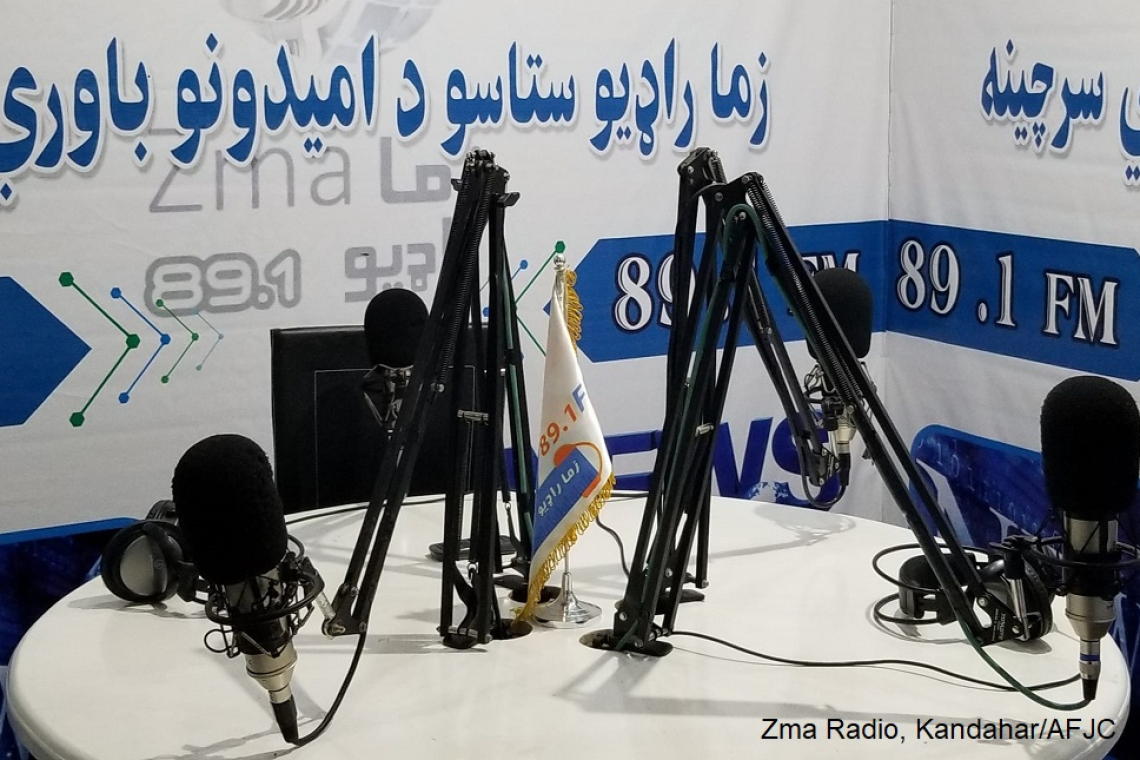
Currently, Kandahar lacks a local television network, as the provincial branch of the national television service ceased operations in August 2024 following a ban on images of living beings. It has since transitioned to a radio format. In addition to this station, there are 11 private radio stations operating in the province, including Sanga, Zama, Waranga, Tabasum, Ziwar, Millat Zagh, Hewad Zhagh, Sama, Taleem ul-Quran, Tahseen ul-Quran, and Ehsas Zhagh.
AFJC condemns these new restrictions as a clear escalation of efforts to suppress free media in Kandahar, which is already grappling with numerous unlawful constraints. AFJC believes that this unprecedented level of censorship poses a significant threat to the survival of local media, which are facing severe economic hardships.
AFJC urges the de facto authorities to reconsider the implications of widespread suppression of freedom of expression on the mental well-being of the population and to uphold freedom of expression as a fundamental human right, consistent with the teachings of Islam.